

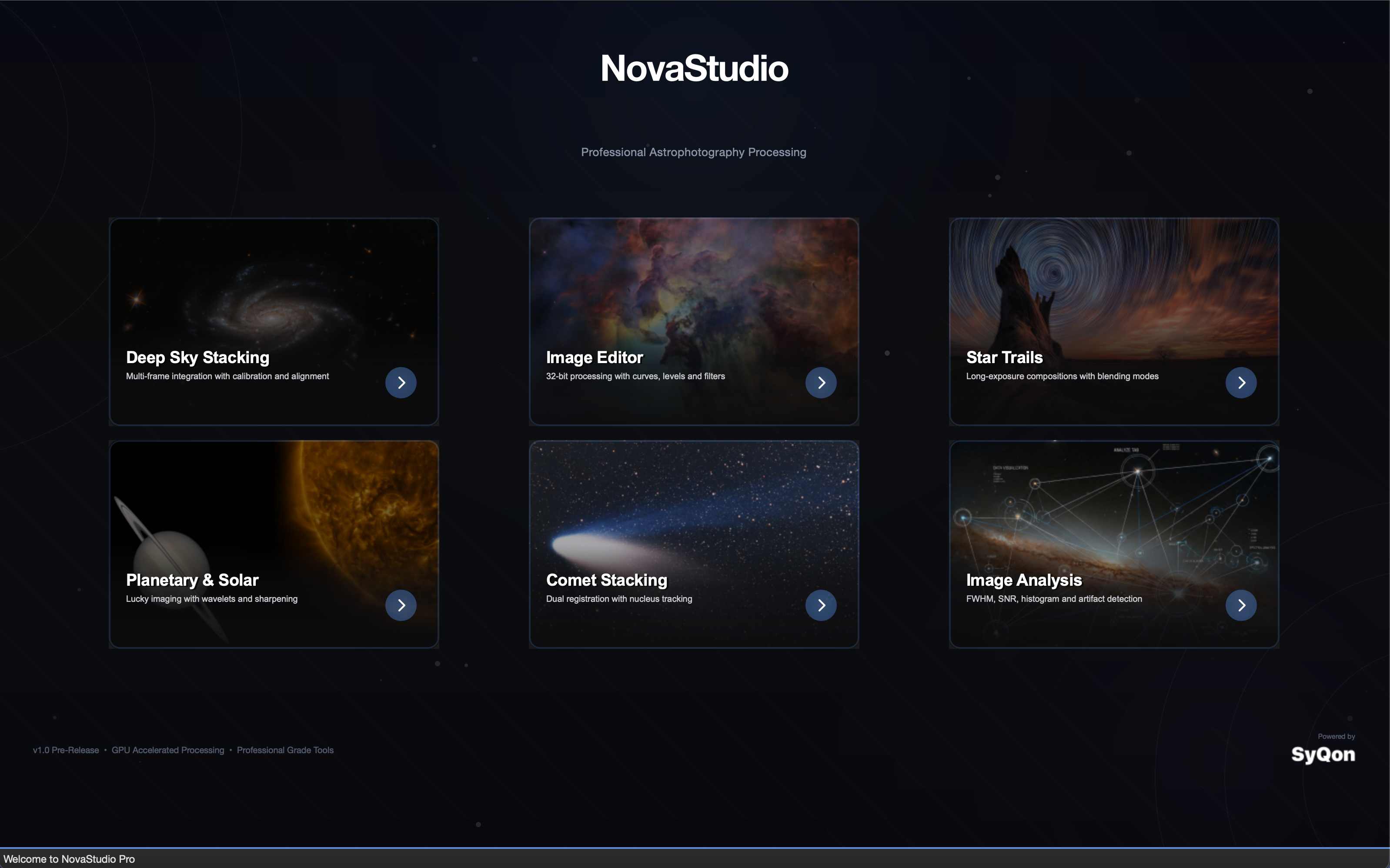
The Foundation Engine.
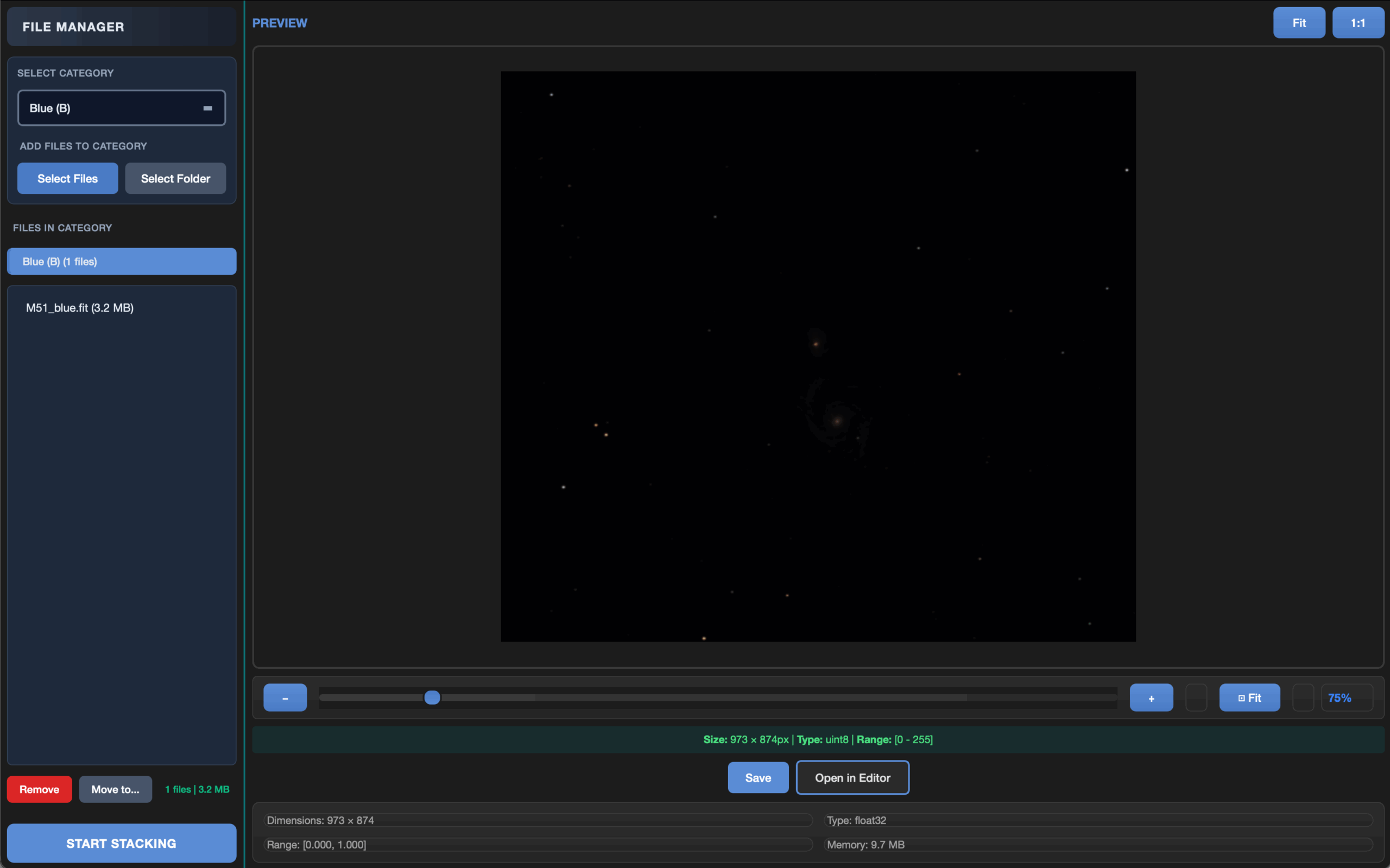
Ultra-fast stacking. Multi-format. Optimized for pristine Signal-to-Noise Ratio and professional-grade resolution across any dataset.
Multi-Format Support
Native handling of FITS, TIFF, JPG, PNG and full RAW support for DSLR and Mirrorless cameras with automatic debayering.
Advanced Integration Algorithms
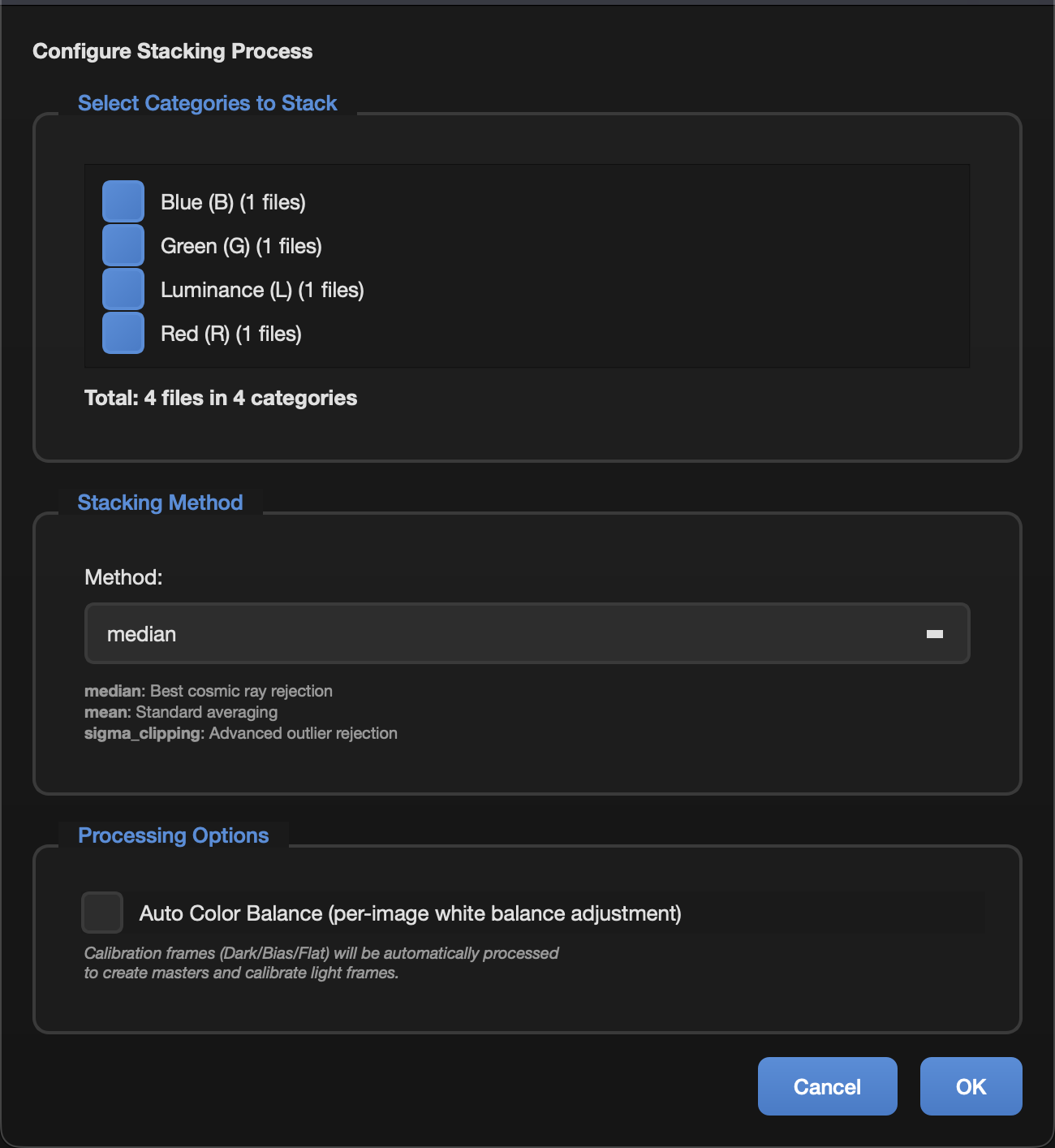
Median, Mean, Sum, Sigma Clipping, Min/Max. Sigma Clipping intelligently removes artifacts and cosmic noise.
Broadband & Narrowband Composition
Works seamlessly with LRGB, OSC, RGB and Narrowband data (Ha, OIII, SII) with fully flexible color mapping.
Pro-Level Automation
Sub-pixel star alignment and optional Auto Color Balance for faster, accurate color reproduction.
The Editor Module.
A scientific pre-processing engine designed for maximum fidelity. It doesn’t perform final creative editing — instead, it applies ultra-advanced, compute-intensive algorithms that reshape data at its core. The process isn’t live. It’s deliberately deep.
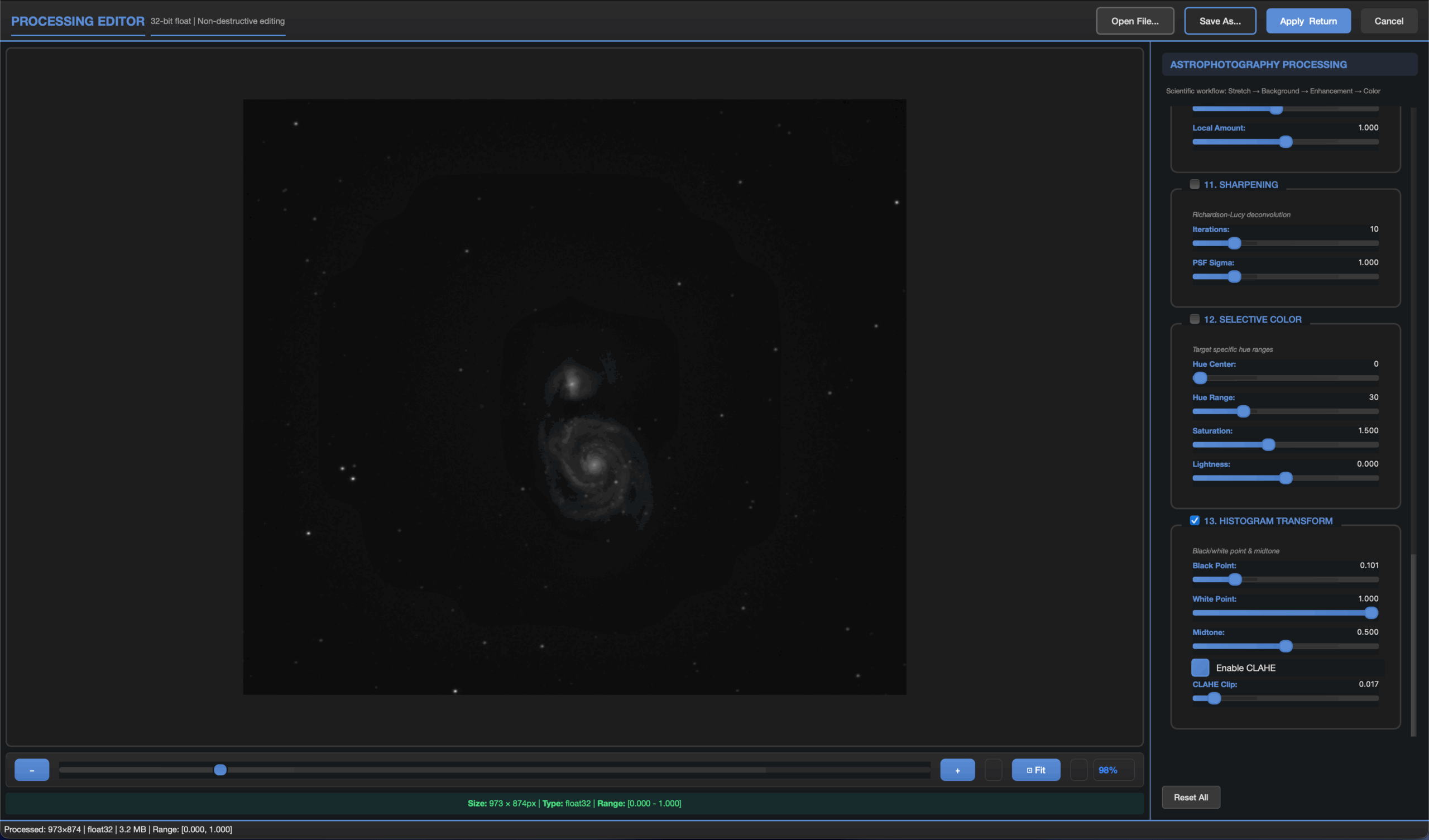
Precision In. Precision Out.
Import JPG, TIFF, PNG and full RAW formats from DSLR and Mirrorless cameras. Export in TIFF 16-bit, TIFF 32-bit floating-point, PNG, or FITS with uncompromised accuracy.
Stretch Algorithms
Generalized Hyperbolic Stretch (GHS), Midtones Transfer Function (MTF), Arcsinh Stretch. Purpose-built to reveal structure without sacrificing dynamic integrity.
Background Extraction
Adaptive Background Extraction (ABE) isolates and removes unwanted gradients with scientific clarity.
Detail Enhancement
Multiscale wavelets, Richardson–Lucy deconvolution, Local histogram equalization. Three complementary approaches to pull out faint, hidden structure.
Color Correction
SCNR noise suppression and Scientific Color Calibration for balanced, physically-grounded chromatics.
Noise & Data Refinement
Noise reduction, hot-pixel removal, gradient removal, HDR multiscale reconstruction, saturation boost, contrast curves, sharpening, selective color, histogram transform. Every tool engineered to elevate raw data without distorting it.
The Startrail Engine.
A dedicated engine built to generate smooth, artifact-free startrails. It handles RAW, JPG and PNG, reconstructing long-exposure paths with precision and no destructive processing.
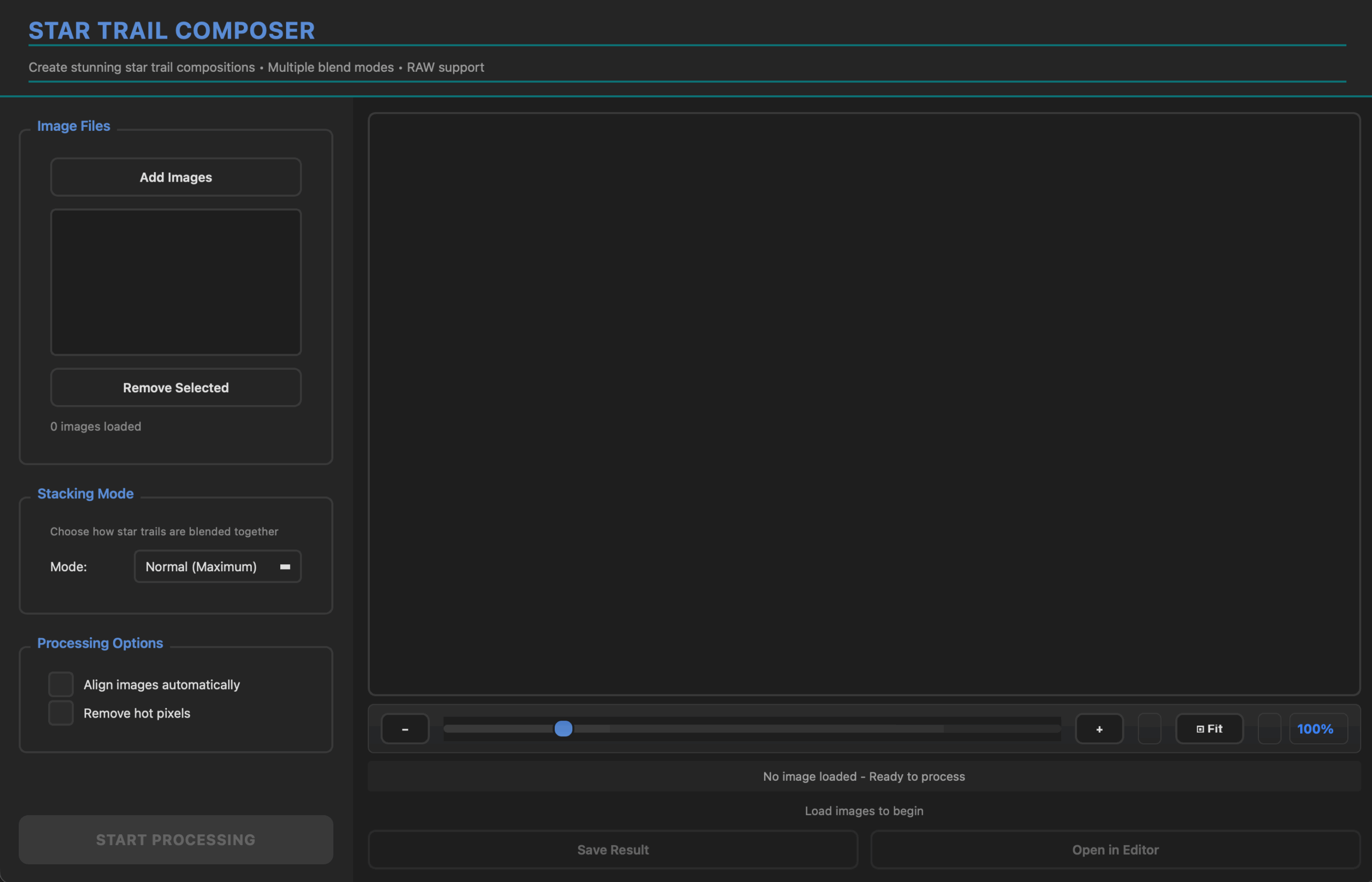
Five Modes. One Purpose.
Every mode is designed to interpret star motion differently — from classic linear trails to comet-style fading. Each process is computed offline, ensuring clean, stable results without sacrificing faint detail.
Normal
Builds standard startrails with natural brightness accumulation and accurate geometry.
Comet
Trails fade progressively, simulating a comet-like motion that feels fluid and cinematic.
Reverse Comet
The tail fades in the opposite direction, for a clean reversed-motion aesthetic.
Lighten Blend
A mathematical lighten-mode blend. Minimal intervention, pure accumulation.
Gap Fill
Reconstructs missing segments caused by clouds, timing gaps or inconsistent exposures.
Planetary & Solar Engine.
A precision video-analysis pipeline built for high-resolution planetary and solar imaging. Supports all major video formats and planetary webcams, delivering deep frame evaluation, sub-pixel alignment and scientific-grade reconstruction.
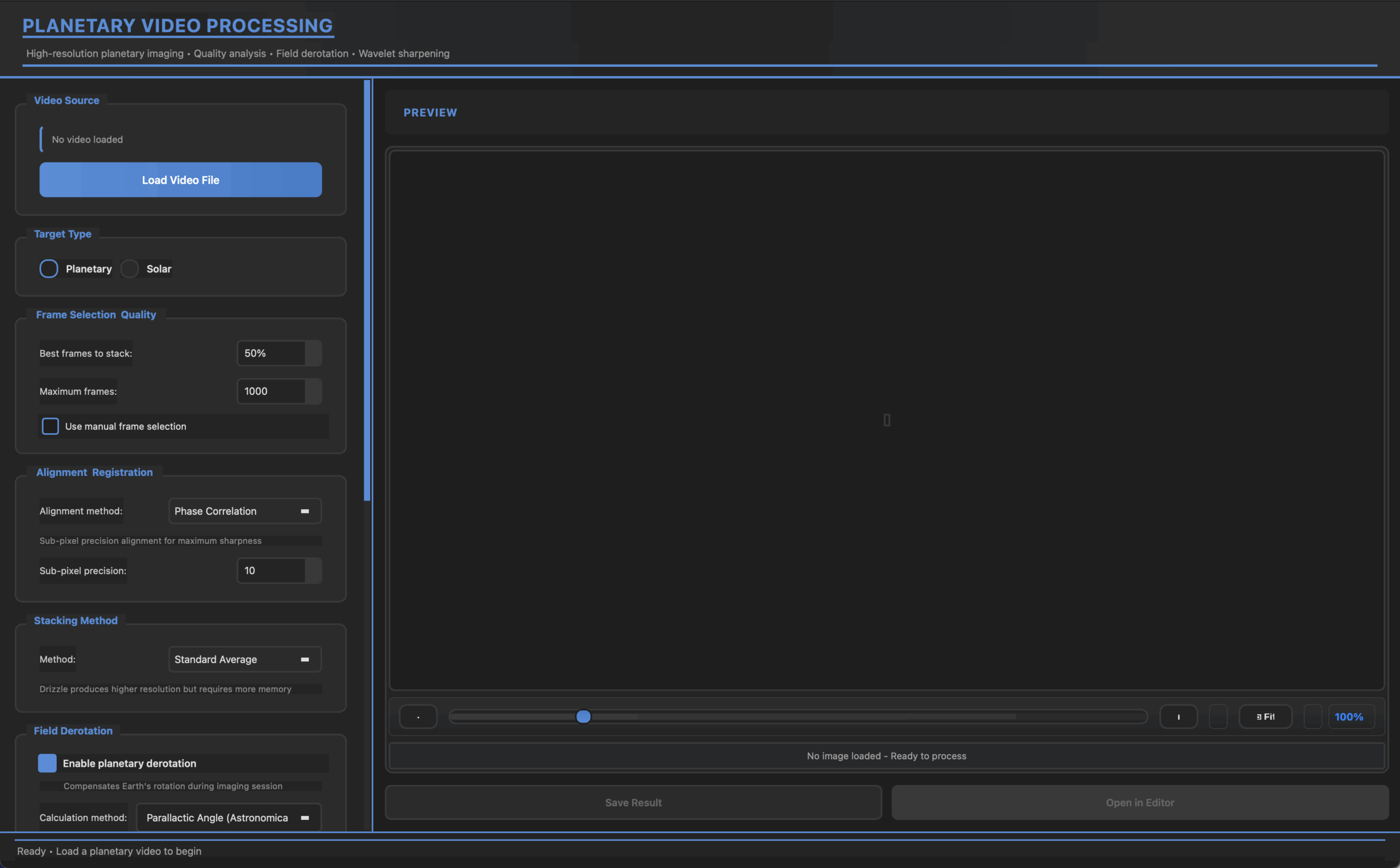
Core Processing Pipeline
Whether you're working in Planetary or Solar mode, the engine applies the same high-precision foundation: best-frame selection, sub-pixel motion correction, stack reconstruction and optional derotation.
Frame Selection
Automatic
Choose a percentage of the best frames or set a maximum frame limit depending on seeing stability.
Manual
Full manual frame selection for expert workflows requiring absolute precision and dataset control.
Sub-Pixel Alignment
Phase Correlation
Frequency-domain alignment ideal for high-contrast scenes and strong atmospheric turbulence.
Feature Detection
Matches planetary surface structures at sub-pixel precision, optimized for Jupiter belts, Saturn rings and lunar detail.
Centroid Tracking
Robust for low-contrast targets, solar granulation or partial occlusions during capture.
Stacking Methods
Standard Average
Ideal for most planetary datasets with stable frame ranking.
Median Stack
Outlier-resistant, excellent for high-frequency solar granulation.
Drizzle 2× / 4×
Oversampling that reconstructs detail beyond the sensor's native pixel resolution.
Derotation Engine
Calculation Method
Parallactic Angle — geometry-based rotational correction.
Auto Detect from Stars — uses stellar motion when available.
Simple Model — fast approximation for short videos.
Interpolation
Lanczos — preserves high-frequency edges.
Fourier — spectral reconstruction for extreme accuracy.
Cubic — smooth and stable for general use.
Solar Mode Extensions
When Solar mode is enabled, the engine adds a dedicated set of astrophysical tools designed specifically for photospheric and chromospheric imaging.
Limb Darkening Correction
Compensates natural solar limb dimming, producing a uniform intensity profile across the disk — essential for scientific analysis and precise granulation reconstruction.
Filter Profile
Tailor the processing pipeline based on the optical band used:
White Light
H-alpha
Calcium K
Continuum
Prominence Enhancement
Available in H-alpha mode. Enhances faint prominence structures without contaminating disk detail.
Post-Processing
RGB Channel Alignment
Corrects atmospheric dispersion and chromatic deviations induced by low-altitude imaging.
Noise Reduction
Removes temporal noise, camera gain noise, and micro-fluctuations typical of short-exposure sequences.
Wavelet Sharpening
Multi-band wavelet enhancement for extreme fine-detail reconstruction — from Jupiter storms to solar granulation.
Comet Engine.
A dual-alignment stacking engine designed for moving targets. Supports FITS, RAW, TIFF and PNG, and adapts the entire pipeline to the unique motion profile of comet nuclei and their surrounding starfields.
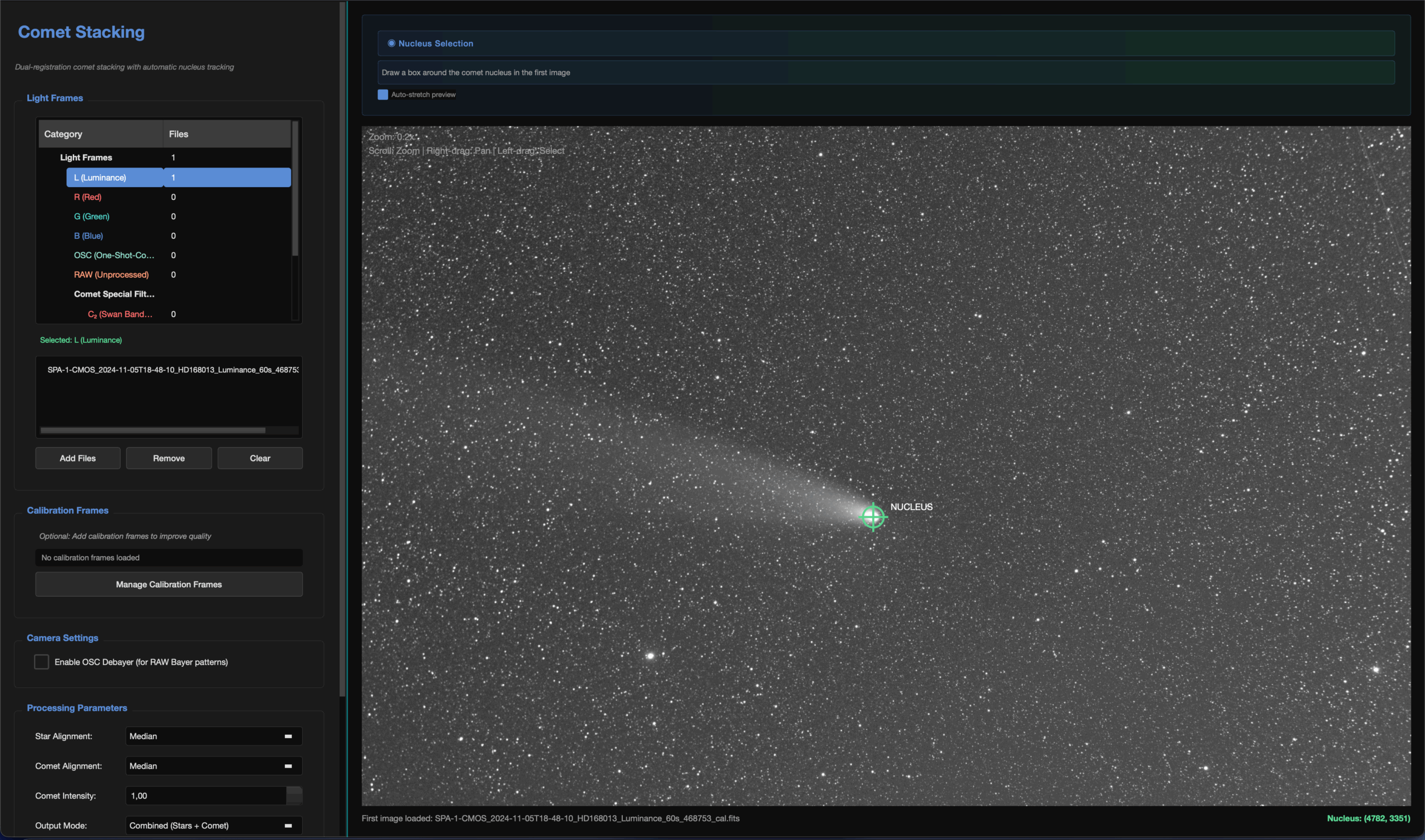
Input Pipeline
The engine accepts FITS, RAW, TIF, and PNG sources, with native support for LRGB and OSC imaging workflows.
Calibration Frames
Apply Dark, Flat and Bias frames prior to stacking to ensure a clean, physically accurate baseline.
Scientific Filters
Specialized bandpasses for cometary science: C2, NH2, and Continuum.
Dual Alignment System
Comet datasets require two independent reference frames: one for the starfield and one for the nucleus.
Star Alignment
Choose between Median, Mean, or Sigma Clipping for robust starfield stabilization.
Comet Alignment
Uses the same statistical cores — Median, Mean, Sigma Clip — but optimized for moving nuclei.
Nucleus Selection
For maximum accuracy, the user selects the comet nucleus directly from a single frame. This becomes the reference anchor for motion compensation across the entire sequence.
Output Modes
Choose how the comet is reconstructed relative to the starfield.
Combined
Stars + Comet. Produces a balanced composite with the comet frozen and stars stabilized — ideal for aesthetic imaging and scientific comparison.
Comet Only
Removes star motion entirely, generating a clean nucleus and tail reconstruction. Perfect for studying structure, jets, and outflow geometry without startrails.
Image Analysis Engine.
A scientific-grade diagnostic system that evaluates optical quality, signal integrity, noise behavior and dynamic range across any loaded frame. Supports JPG, PNG, TIFF and FITS.
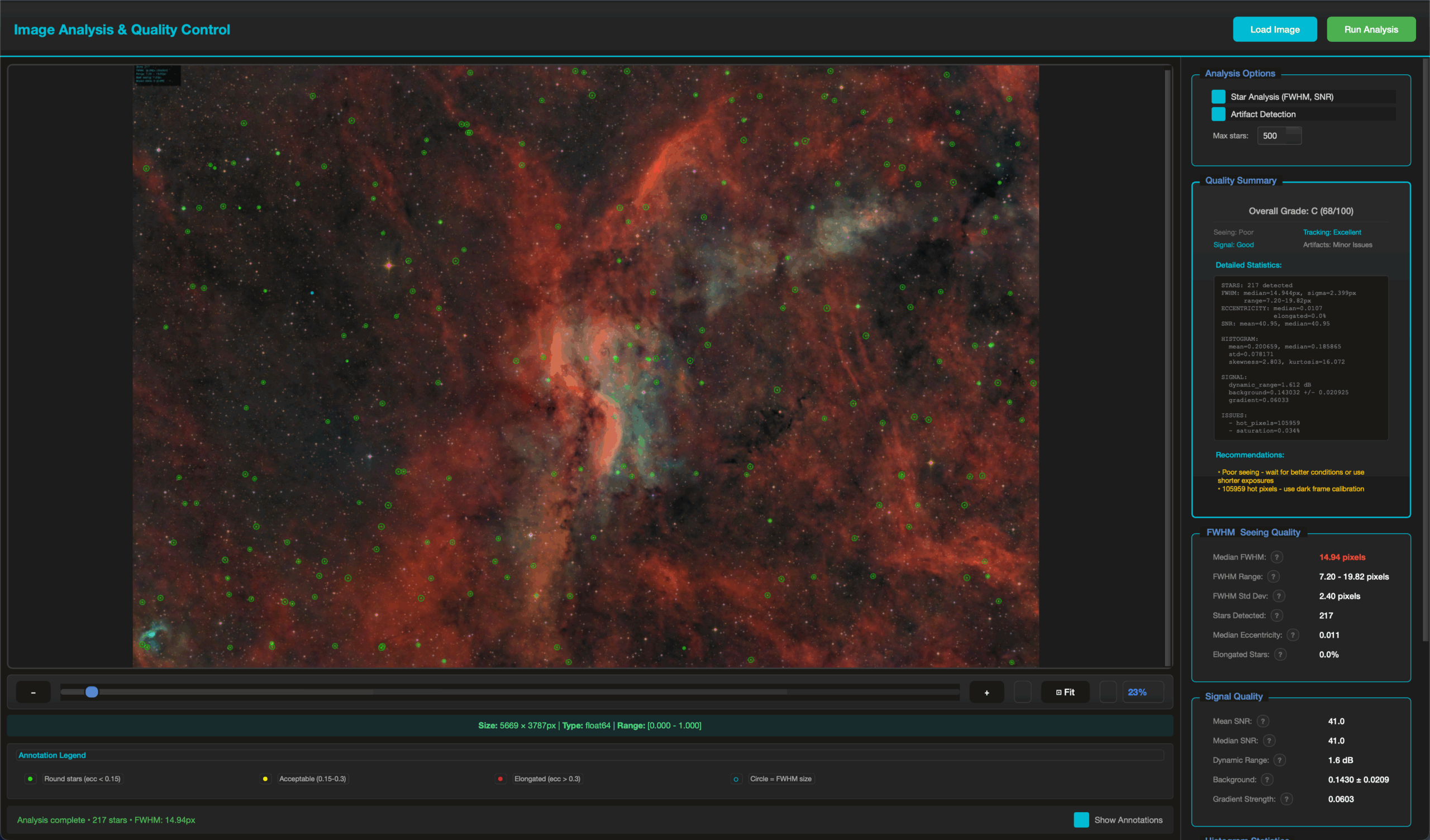
Overall Grade
An aggregated quality index combining optical performance, signal integrity and artifact presence. It serves as a global score to quickly assess the scientific fitness of the frame.
Seeing & Tracking
Measures atmospheric turbulence and mount stability by analyzing star shape, motion blur and high-frequency structure loss.
FWHM Metrics
FWHM (Full Width at Half Maximum) quantifies stellar sharpness. Lower values indicate tighter stars and better seeing.
Median FWHM
Typical sharpness level across all detected stars.
Range
Difference between the sharpest and softest stars.
Standard Deviation
Variability in FWHM — high STD indicates unstable seeing.
Stars Detected
Number of identified stars used for optical and tracking diagnostics.
Median Eccentricity
Measures star roundness. Higher eccentricity indicates distortion or mount drift.
Elongated Stars
Percentage of stars stretched beyond acceptable thresholds.
Signal Quality
Evaluates the statistical strength of the signal compared to noise, along with background behavior and illumination balance.
Mean SNR
Average signal-to-noise ratio across the image.
Median SNR
More robust central estimate of SNR, ignoring outliers.
Dynamic Range
Difference between brightest and darkest resolved values.
Background Level
Mean background intensity — indicates sky brightness or sensor offset.
Gradient Strength
Measures the presence of uneven illumination caused by light pollution, vignetting or optical tilt.
Histogram Statistics
A mathematical description of pixel distribution, used to infer exposure balance, photometric behavior and data regularity.
Mean Value
Average pixel intensity.
Median Value
Midpoint intensity — robust indicator of exposure.
Standard Deviation
Contrast variability in the dataset.
Skewness
Asymmetry of the histogram. Positive skew = brighter tail; negative = darker concentration.
Kurtosis
Sharpness or “peakedness” of distribution — reveals clipping or excessively flat exposures.
Artifact Detection
Identifies structural defects introduced by sensors, optics or environmental contamination.
Banding Detected
Reports presence of horizontal/vertical sensor banding.
Banding Strength
Quantifies severity via frequency-domain energy.
Hot Pixels
Number of thermally saturated pixels or defective sites.
Saturated Pixels
Pixels clipped to maximum brightness — indicates overexposure.